Manuel Villoria presented the main results of the implementation of the agency in 2025, updated to May 2026. Among the main challenges mentioned the consolidation of the organization, the reform of Law 2/2023, of February 20, and the signing of agreements with the Autonomous Communities so that it can be protected and punished equally throughout the territory.
The president of the AIPI reports to the Justice Commission of the Congress of Deputies on the activity of the institution during 2025
26/05/2026
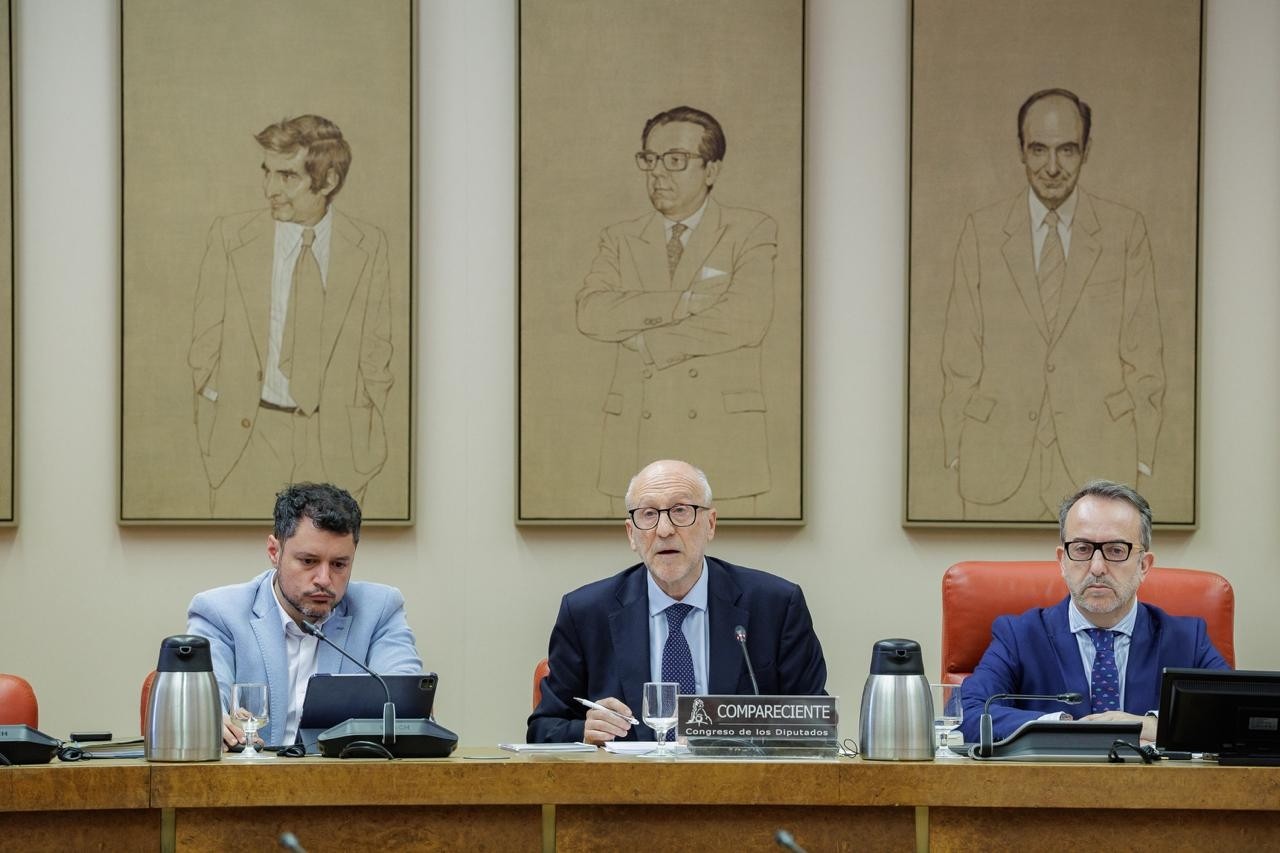
The president of the Independent Authority for the Protection of the Informant, A.A.I., (AIPI), Manuel Villoria Mendieta, presented on the 26th to the Justice Commission of the Congress of Deputies the annual report corresponding to the four months of operation of the entity in 2025. In his speech, Villoria Mendieta said that from the first moment the priority has been to enable the presentation of communications by the informants despite having few means.
Of the 174 communications received in 2025, one third were anonymous. Twenty-six requests for protection were received, of which 17 were granted. In five cases, proceedings were initiated for possible reprisals or breaches of confidentiality and other requirements of Law 2/2023, of February 20, regulating the protection of persons who report on normative violations and the fight against corruption. AIPI’s activity is growing, he said, and so far in 2026 (as of 20 May, 414 new communications and 43 requests for protection have been registered, 15 of which have been granted).
Construction of the organization
Building the organization itself, from scratch, with no record in the General Administration of the State on the matter, also occupies and worries the president of the AIPI. In this regard, he highlighted the support in those initial months of the Ministry of the Presidency, Justice and Relations with the Courts, which, in a context of extended budgets, provided budgetary and logistical (especially technological) support to start up the institution.
In his speech, Manuel Villoria called for more means to carry out the functions that Law 2/2023 entrusts to the AIPI, since it closed 2025 with 11 posts covered by a List of Jobs of 18, with a budgetary cost intended to cover the payroll of personnel and the expenses derived from the ordinary operation.
Despite these difficulties, significant progress has been made:
-The electronic headquarters of the Authority has been created.
-The AIPI information system has been designed.
-The external channel has been put into operation, essential for the reception of information and communications and for the protection of informants.
-And the first protective actions have been initiated.
And he highlighted as a success case of these first actions, but as early as 2026, the design and management of the communication form of the designation of those responsible for the internal information systems of public and private entities, whose initial deadline of two months was enabled from February 9, 2026.
Lack of time has not allowed the initiation of sanction proceedings in 2025, but efforts have been made to establish solid methodological bases that will ensure future actions, both methodologically and legally.
The president of the AIPI detailed in his speech at the Congress other activities carried out in these first months of action, such as recommendations, resolution of consultations on the interpretation of Law 2/2023, of February 20, or the operation of the internal information systems that have to be installed by both public administrations and many companies.
Relationship with the Autonomous Communities
The application of Law 2/2023, of February 20, has been developed by the Autonomous Communities at different speed. Thus, some Autonomous Communities (eight in 2025, to which two others have joined very recently) have created specific authorities for the protection of informants, although the competences assumed have different scope.
Manuel Villoria warned that the law does not empower the AIPI to act in a residual way, so that, in the remaining autonomous communities, which lack their own mechanisms, the State Authority cannot act as an external channel (receive information) or protect the people who complain.
The solution to this problem of inequality (with the risk of sanction by the European Commission) is for the Autonomous Communities to sign specific agreements with the Authority. In this regard, Villoria Mendieta urged the Autonomous Communities to immediately commit themselves to the creation of authority and the assumption of their competences or to the signing of the agreement with the AIPI, which includes an economic clause in which the signatory Community assumes the cost of providing the service.
Legislative amendment
The President of the AIPI stressed that, in order to guarantee the protection of informants correctly, that is, in compliance with the provisions of Directive EU 2019/1937 of the European Parliament and of the Council, of October 23, 2019, on the protection of persons who report infringements of Union law, it is necessary to modify Law 2/2023, in some specific issues. To reach a consensus on these proposals, work has been done in a working group with the Autonomous Communities.
These proposals include extending the scope of the protection afforded to individuals, both in time and in the type of conduct that can be reported, since some of them are not crimes, but are enormously harmful to the public interest; and also extending some current restrictions of the rule when admitting protection (for example, if their communication in an internal channel has been previously inadmissible).
It also wants to include in the regulation the possibility of adopting precautionary measures in terms of protection, and also to protect those responsible for internal and external systems from possible pressures, as well as the extension of the period of action in the sanctioning regime, currently limited to only three months, manifestly insufficient for complex dossiers that require extreme guarantees of legal security.
The comparison is available in the congress website.